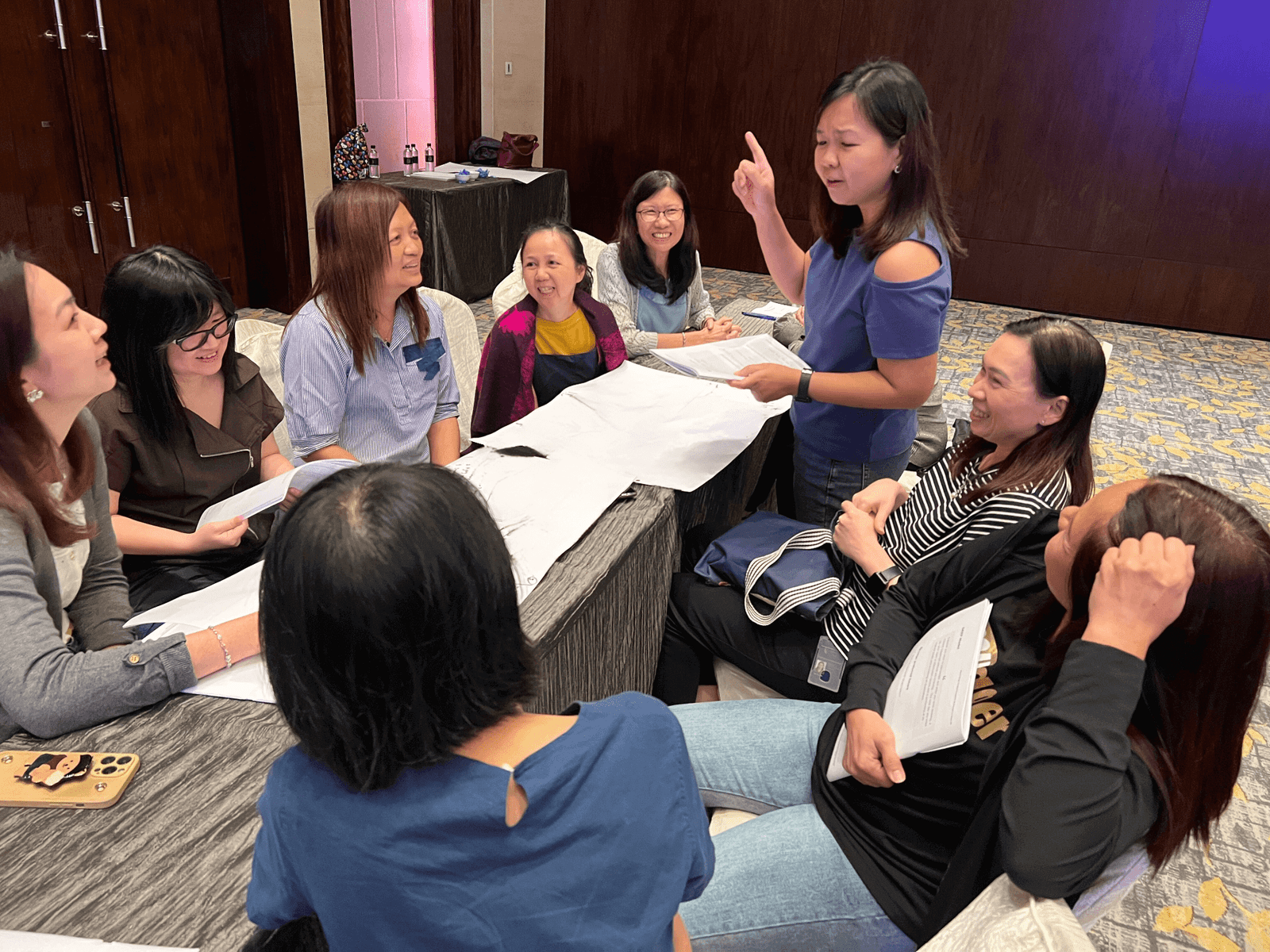
For First-Time Managers, Newly Promoted Team Leads, and Organisations Supporting Them
First-Time Manager
Training
In Singapore
New manager training that prepares your best individual contributors to lead people — before the first hard conversation, not after it.
Most people are promoted because they were excellent at the job — not because they were ready to lead the people who now do it. That gap shows up fast: avoided feedback, weak delegation, over-involvement, and uncertainty when leading former peers. This programme helps new managers build the confidence and habits they need in their first 90 days, using real workplace situations rather than textbook cases.
Tell us whether you are supporting one newly promoted manager or a full cohort. We'll recommend the right format, sequence, and level of customisation.
Useful for HR teams planning a cohort, and for newly promoted managers who know they need to build confidence quickly.
Programme Snapshot
Duration
1 to 2 days, or split into shorter virtual sessions across 2-4 weeks
Best For
Newly promoted managers, team leads, and supervisors in their first people-leadership role
Delivery
In-person in Singapore or virtual
Format
In-house private cohort, customised to your organisation
Methodology
Applied scenarios and live practice using your real workplace situations
Trusted By Leading Organisations Across Singapore And The Region
Deep Impact has helped organisations across Singapore turn strong individual contributors into confident people managers since 2007.
















The Short Answer
What Is First-Time Manager Training?
First-time manager training is structured leadership development for employees who have just been promoted into their first people-management role. It teaches the skills that individual contributor work never required - delegating, giving feedback, coaching, and leading people who were recently peers - so that new managers build the right habits early instead of learning by trial and error on their teams.
In Singapore, Deep Impact delivers this as a customised in-house programme rather than a public course. Content is built around your organisation's real situations, so what new managers practise in the room is what they face the following week. It is also useful for newly promoted managers who want to prepare early rather than learn through avoidable mistakes.
Request A Proposal For Your Team arrow_forwardWho it is for
Employees who have recently been promoted into their first people-management role, plus team leads and supervisors preparing to take one on.
What it covers
The shift from individual contributor to manager: delegation, feedback, coaching conversations, leading former peers, running one-to-ones, and handling the first difficult performance conversation.
How long it takes
Typically 1 to 2 days in a full-immersion format, or the same content split into shorter virtual sessions across 2 to 4 weeks.
Where it is delivered
Delivered in-house at your Singapore office, at an external venue, or virtually for distributed teams across the region.
Who delivers it
Deep Impact Pte Ltd, a Singapore-based leadership training consultancy founded in 2007. Programmes are led by senior Deep Impact consultants with 10+ years of leadership development experience.
How it is priced
Quoted per cohort rather than per seat, based on group size, number of days, and how much customisation the content requires. Request a proposal for a figure specific to your organisation.
The Real Problem
Six Shifts Nobody Trains New Managers To Make
Promotion changes the job description overnight. It does not change the instincts. Leadership training for new managers works when it targets the specific shifts that trip people up in the first few months - not general management theory.
In research on 295 first-time managers, 59.3% named adjusting to people management and displaying authority among their top three leadership challenges - ahead of every technical or functional concern.
Center for Creative Leadership, 2014 open_in_new
Being valued for your own output
Being valued for your team's output
The habits that earned the promotion - doing it yourself, doing it fast, doing it well - are the habits that now cap the team. New managers have to learn to measure themselves by what the team ships, not what they personally finish.
Doing the task
Delegating the task
Most new managers delegate the work but keep the worry, then take the task back the moment it looks wobbly. We practise handing over outcomes with clear standards and check-in points, so delegation survives contact with a nervous week.
Being one of the team
Leading the team you were in
Leading former peers is the single most common reason a first-time manager stalls in Singapore workplaces. We work through how to reset the relationship openly, hold a standard without becoming distant, and handle the colleague who wanted the role.
Avoiding difficult conversations
Having them early and well
Feedback deferred becomes a performance problem. New managers learn a structure for raising an issue while it is still small, and get to rehearse it on a real situation before they have to run it live.
Having the answers
Asking the questions
The fastest way to build a dependent team is to solve everything for them. We introduce coaching questions that develop the person's own thinking - the same solution-focused approach used across our senior leadership work.
Managing your own calendar
Running the team's rhythm
One-to-ones that get cancelled, team meetings that end without decisions, priorities that drift. New managers leave with a working weekly operating rhythm they can run from day one.
Why It Matters
Most Managers Are Trained A Decade Too Late
The case for training people at the point of promotion rather than years into the role is not a marketing argument - it is what the research consistently shows.
14%
Of Singapore's workforce is engaged at work
Just 14% of employees in Singapore are engaged - below the Southeast Asian average of 25% and the global average of 20%. Everyday management is the closest lever most organisations have to this number.
Gallup, Singapore Workplace Report 2026 open_in_new70%
Of the variance in team engagement traces to the manager
Gallup finds managers account for at least 70% of the variance in employee engagement scores across business units - more than any other single factor an organisation controls.
Gallup, State of the American Manager (2015) open_in_new42
Average age at first formal leadership training
In Zenger Folkman's database of 17,000 leaders, the average person entering leadership training was 42 - yet people typically become supervisors around age 30. Most managers spend a decade forming habits before anyone trains them.
Jack Zenger, Zenger Folkman / Harvard Business Review (2012) open_in_newThe cost of underprepared managers shows up early — in missed feedback, weak delegation, inconsistent standards, and teams that lose confidence fast.
The Programme
What New Manager Training Covers
Four core modules, sequenced in the order new managers actually hit these problems. Every module ends in live practice on a real situation the participant brought into the room.
01
From Contributor To Manager
Reset what the job actually is now
- check Understanding what changed on promotion day - and what did not
- check Judging your own week by team output rather than personal output
- check Recognising the rescue reflex and choosing a different response
- check Setting expectations with your own manager about the new role
Applied Practice
Map your current week against what a manager's week should contain, and identify what to stop doing
02
Delegation & Accountability
Hand over the work without handing over the standard
- check Deciding what to delegate, to whom, and at what level of autonomy
- check Briefing an outcome clearly enough that it comes back right
- check Agreeing check-in points so following up is not micromanaging
- check Holding the line when work comes back incomplete
Applied Practice
Rehearse a real delegation conversation for a task you are currently holding on to
03
Feedback & The First Difficult Conversation
Raise the issue while it is still small
- check A repeatable structure for corrective feedback that protects the relationship
- check Separating the behaviour from the person under pressure
- check Managing your own reaction when the response is defensive or emotional
- check Leading former peers, including the colleague who wanted the role
Applied Practice
Live practice on a real situation each participant is currently avoiding
04
Coaching Habits & Team Rhythm
Build a team that thinks, not a team that asks
- check Asking questions that develop thinking instead of supplying answers
- check Running one-to-ones that people do not want cancelled
- check Running team meetings that end in decisions and owners
- check Establishing a weekly operating rhythm you can sustain
Applied Practice
Design your own 90-day operating rhythm and first-month one-to-one agenda
Commonly Added To A First-Time Manager Pathway
Organisations building a longer runway for new managers often sequence one or more of these modules after the core programme.
The First 90 Days
What A New Manager Should Do In Their First 90 Days
This is the roadmap participants leave the programme with. It is deliberately unglamorous - the first three months are won by listening carefully, setting expectations explicitly, and delegating earlier than feels comfortable.
Days 1-30
Listen And Reset The Relationship
Understand the team before changing it, and openly reset the peer relationships that have just changed.
- check_circle Hold a one-to-one with every team member and ask what is working, what is not, and what they need from you
- check_circle Name the transition out loud with former peers rather than hoping it settles by itself
- check_circle Agree with your own manager what success looks like at 90 days
- check_circle Resist making structural changes in the first month
Days 31-60
Set The Standard And Start Delegating
Move from observing to leading: make expectations explicit and begin handing work over properly.
- check_circle State clearly what good looks like for the work your team owns
- check_circle Delegate two things you are still doing yourself, with agreed check-in points
- check_circle Give your first piece of corrective feedback while the issue is still small
- check_circle Establish a weekly team rhythm - one meeting that ends in decisions, one-to-ones that hold
Days 61-90
Coach, Delegate Deeper, And Review
Shift from directing to developing, and check honestly whether the new habits are holding.
- check_circle Replace answer-giving with coaching questions in at least half your one-to-ones
- check_circle Delegate something genuinely uncomfortable to let go of
- check_circle Ask the team directly for feedback on how you are leading
- check_circle Review the 90-day expectations you agreed and recontract for the next quarter
Engagement Models
How Organisations Run First-Time Manager Training
Choose the model that fits how often you promote and how far ahead you can plan.
01
Single New-Manager Cohort
Run the core programme once for the managers you have just promoted. The most common starting point for organisations promoting in small batches through the year.
02
Promotion-Cycle Programme
Run the programme on a fixed cadence tied to your promotion cycle, so every new manager gets the same grounding in their first quarter rather than whenever a budget allows.
03
Pre-Promotion Readiness Track
Train high-potential individual contributors before they are promoted, so they step into the role already equipped. Often paired with a broader leadership pipeline or succession plan.
Every engagement is customised to your organisation's structure, team maturity, and promotion pipeline.
Get Started
Tell Us About Your Training Needs
Share your audience, priorities, and timeline. We'll recommend the most suitable module or pathway for your organisation.
Typically responds within 1 business day
No obligation - just a conversation
Personalised recommendation for your team
Promoting Managers This Quarter?
Tell us how many, and when they step into the role. We'll recommend the right format and timing — for your next cohort or for a newly promoted manager who needs support now.
About Deep Impact
19+ Years Developing Leaders Across Asia
Deep Impact is a Singapore-based leadership training consultancy founded in 2007. We've impacted over 43,000+ professionals across 285+ clients in 40+ countries - from C-suite executives to first-time managers.
Every program is customised to your organisation's challenges, culture, and goals. We don't do off-the-shelf - that's why the results stick.
FAQ
First-Time Manager Training Questions
Straight answers to what HR, L&D, and line leaders ask before committing a cohort of new managers.
Ask Us About Your New Managers arrow_forwardGet It Right The First Time
Give New Managers More Than A Title
Your strongest individual contributors deserve a better start than working it out alone. Tell us who you are promoting and when, and we'll shape a programme around the situations they are about to walk into.
Whether you are planning training for a cohort or you are a newly promoted manager trying to get ahead of the learning curve, we can help you identify the right next step.
Typically responds within 1 business day