 Book Free Consultation
“Leadership is not an inherited trait but a cultivated capability. Great leaders are shaped through reflection, learning, and purposeful action.”
In today’s business, the most important leadership competencies serve as the backbone of organisational resilience, growth, and performance. Organisations navigating rapid technological innovation, market disruption, and operational transformation cannot rely solely on strategy, technology, or processes. Leadership continues to distinguish organisations that thrive from those that struggle to achieve their objectives.
Evidence demonstrates that companies with well-defined leadership competency frameworks outperform their peers in engagement, profitability, and innovation. The Center for Creative Leadership (2024) found that the organization investing in leadership development are 3.4 times more likely to be recognised as “excellent” workplaces while achieving measurable business outcomes (CCL, 2024). Developing leadership competencies ensures that organisations not only survive change but also harness it for growth, employee engagement, and long-term success.
This article explores three core categories of leadership competencies: leading the organisation, leading others, and leading the self. It offers practical guidance for HR professionals, managers, and current or aspiring leaders seeking to develop critical leadership skills and cultivate a thriving organisational culture.
Why Leadership Competencies Matter
Leadership competencies are the combination of knowledge, skills, and behaviours that enable leaders to influence teams, achieve business objectives, and build high-performing organisations. While technical expertise remains vital, research increasingly emphasises the value of soft skills. Emotional intelligence, communication, adaptability, and learning agility are no longer optional; they are essential for leaders seeking to guide teams through complexity.
Deloitte (2023) reported that companies with strong leadership performance achieve:
- 21% higher profitability
- 17% growth in revenue
- 14% lower voluntary turnover
- Enhanced succession planning and leadership effectiveness
Despite these advantages, only 40% of organisations consider their leaders competent across all critical leadership competencies. Gaps often exist in areas such as change management, people management, and self-management. Structured leadership development programs aligned with competency frameworks can address these gaps, fostering stronger leadership pipelines and sustainable business performance.
Understanding Leadership Competency Framework
A leadership competency framework acts as a blueprint for defining, measuring, and developing leadership skills within an organisation. These frameworks enable HR leaders to assess potential, guide planning, and align leadership performance with strategic business priorities.
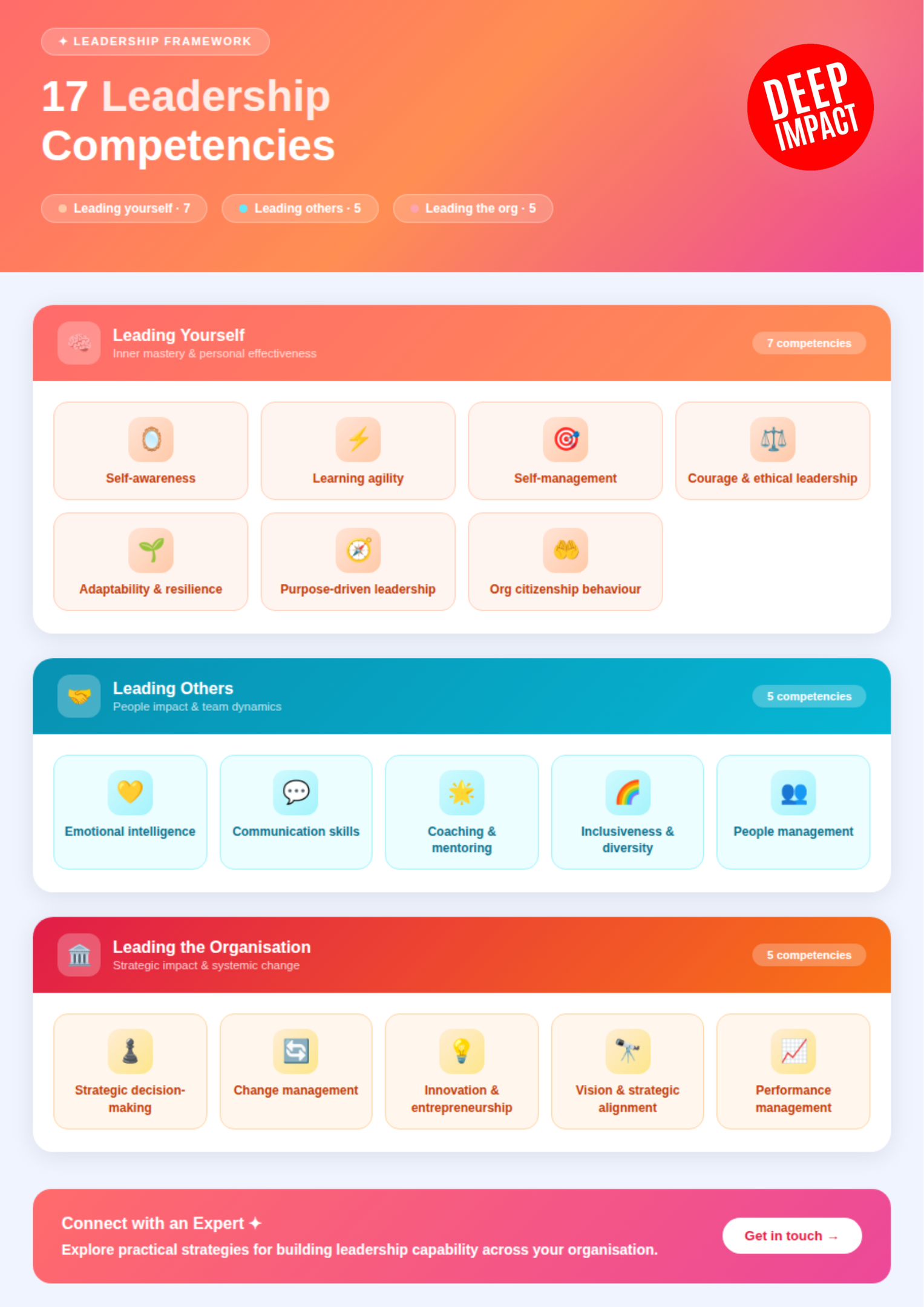
Effective frameworks include three interconnected components:
- Competencies for leading the organisation – strategic decision-making, innovation, and change management.
- Competencies for leading others – people management, emotional intelligence, coaching, and inclusiveness.
- Competencies for leading the self – awareness, learning agility, resilience, and well-being.
Integrating these competencies into organisational practice ensures leaders can guide teams effectively, nurture a positive company culture, and make employees feel valued and motivated. This integration also enhances retention, engagement, and overall organisational performance.
Competencies for Leading the Organisation
1. Strategic Decision-Making
Leaders who can analyse complex situations, anticipate consequences, and make informed decisions provide organisations with a competitive advantage. Evidence shows that organisations with leaders strong in strategic thinking and problem-solving outperform peers in adaptability, efficiency, and innovation (Harvard Business Review, 2025).
Actions for leaders:
- Evaluate multiple solutions before taking action
- Incorporate feedback from team members and stakeholders
- Align decisions with the organisation’s vision and long-term goals
Strategic decision-making is not limited to top executives; emerging leaders also benefit from exposure to real-world problem-solving scenarios that challenge their critical thinking.
2. Change Management
Leading through change requires more than communicating new processes; it demands understanding human reactions, alleviating uncertainty, and maintaining performance under evolving conditions. Effective leaders can guide teams through transitions while sustaining morale and productivity.
Skills for leaders:
- Simplify complex changes for clarity
- Communicate consistently and transparently
- Encourage participation and collaboration during transitions
Organisations that develop change management as a core competency are more likely to achieve smooth adoption of new technologies, operational practices, and strategic initiatives.
3. Innovation and Entrepreneurial Thinking
Innovation fuels long-term competitiveness. Leaders with an entrepreneurial mindset inspire creativity, embrace calculated risk-taking, and reward experimentation. Encouraging employees to challenge norms and propose ideas fosters a culture of continuous improvement.
Indicators of innovation leadership:
- Implementing solutions that improve products or services
- Encouraging cross-team collaboration and ideation
- Learning from failures to strengthen organisational processes (MIT Sloan Management Review, 2024)
Leaders who prioritise innovation ensure the organisation remains agile, adaptive, and relevant in dynamic markets.
4. Vision and Strategic Alignment
A compelling vision motivates employees by connecting daily work to broader organisational goals. Leaders who articulate this vision inspire engagement and commitment, creating alignment across departments and leadership role.
Behaviours for leaders:
- Clearly communicate the organisation’s future direction
- Demonstrate self-awareness when making strategic decisions
- Monitor leadership performance to ensure alignment with objectives
Without strategic alignment, even highly skilled teams may fail to achieve business goals efficiently.
5. Performance Management
Performance management ensures employees understand expectations, receive regular feedback, and have opportunities for professional growth. It is a key lever for sustaining motivation and improving outcomes.
Best practices:
- Set measurable objectives and Key Performance Indicators(KPIs)
- Provide timely, constructive feedback
- Implement succession planning for long-term leadership continuity
High-performing organisations tie performance management to competency development, reinforcing a culture of accountability and growth.
Competencies for Leading Others
6. Emotional Intelligence
Emotional intelligence (EI) enables leaders to build strong interpersonal relationships, resolve conflicts, and enhance team engagement. Leaders with high EI cultivate environments where employees feel valued, heard, and motivated.
Core EI components:
- Self-awareness and self-regulation
- Empathy for team member
- Social skills that facilitate collaboration and communication (Goleman, 2023)
EI impacts employee satisfaction, retention, and team cohesion, making it a critical leadership competency.
7. Coaching and Mentoring
Effective coaching transforms potential into performance. Leaders guide others by providing constructive feedback, setting development goals, and fostering accountability.
Best practices:
- Holding conversations for reflection and response to situations
- Encourage learning agility and experimentation
- Offer actionable, performance-oriented feedback
Organisations that prioritise coaching benefit from accelerated talent development and stronger succession pipelines.
8. Inclusiveness and Diversity
Inclusive leadership drives innovation, engagement, and equitable opportunities. Organisations with inclusive practices report 2.3 times higher innovation revenue than those that neglect diversity (Harvard Business Review, 2023).
Behaviours for leaders:
- Recognise and mitigate unconscious biases
- Ensure participation from all team members
- Promote psychological safety to encourage idea-sharing
Inclusive cultures retain top talent, attract diverse candidates, and strengthen organisational reputation.
9. Communication Skills
Leaders must communicate with clarity, consistency, and empathy. Mastery in communication ensures that strategies, goals, and expectations are understood, while fostering engagement and conflict resolution.
Indicators of effective communication:
- Active listening paired with concise messaging
- Tailoring communication to different audiences
- Seeking and incorporating feedback to improve understanding
High-performing leaders model communication excellence, influencing both organisational culture and team performance.
10. People Management
Strong people management balances delegation, motivation, guidance, and employee development. Leaders ensure teams are aligned, productive, and engaged while nurturing professional growth.
Best practices:
- Align individual objectives with business goals
- Monitor morale and leadership effectiveness
- Offer growth and development opportunities
Organisations that invest in people management competencies report higher employee satisfaction, retention, and overall productivity.
Competencies for Leading the Self
11. Self-Management
Managing personal priorities, energy, and time is foundational for sustainable leadership. Leaders who master self-management model balance and discipline for their teams.
Key actions:
- Prioritise and plan daily tasks effectively
- Maintain work-life balance and personal well-being
- Reflect on leadership effectiveness regularly
Self-managed leaders reduce burnout, enhance decision-making, and inspire team resilience.
12. Learning Agility
Learning agility equips leaders to adapt quickly to new challenges, apply lessons from past experiences, and foster continuous improvement. Leaders with this competency drive organisational innovation and growth.
Behaviours include:
- Seeking novel experiences and knowledge
- Unlearning outdated practices
- Promoting ongoing learning within teams (McKinsey, 2024)
Agile learners prepare organisations to pivot quickly in response to market or operational shifts.
13. Self-Awareness as Leadership Development
Self-aware leaders understand their strengths, limitations, and impact on others. This awareness supports informed decision-making, emotional regulation, and effective team engagement.
Actions for self-awareness:
- Solicit feedback from colleagues and team members
- Reflect on personal decisions and leadership behaviours
- Align actions with organisational values
Leaders who know themselves enhance trust, credibility, and influence across the organisation.
14. Courage and Ethical Leadership
Ethical, courageous leaders uphold values, take calculated risks, and defend teams even in challenging circumstances. This builds trust, credibility, and a culture of integrity.
Behaviours include:
- Standing by difficult decisions
- Upholding ethical standards consistently
- Promoting transparency and accountability
Ethical leadership strengthens organisational reputation and ensures long-term stakeholder confidence.
15. Organisational Citizenship Behaviour (OCB)
OCB encompasses voluntary actions that support colleagues and the organisation beyond formal duties. Leaders who demonstrate OCB set a culture of engagement, collaboration, and initiative.
These “above and beyond” behaviors—such as helping coworkers, maintaining a positive attitude, and supporting organizational changes—are not directly recognized by reward systems but enhance overall workplace functioning.
Examples:
- Mentoring peers and juniors
- Volunteering for cross-functional projects
- Encouraging proactive problem-solving
OCB fosters a sense of purpose, loyalty, and community within organisations.
16. Purpose-Driven Leadership
Connecting business objectives with a broader organisational mission inspires commitment and engagement. Purpose-driven leaders create meaning in daily work and align teams toward shared goals.
Actions include:
- Embedding organisational values into initiatives
- Aligning team objectives with strategic impact
- Recognising and rewarding contributions that advance the mission
Purpose-driven cultures retain talent and motivate high performance across all leadership level.
17. Adaptability and Resilience for Business Success
Adaptable leaders maintain focus and effectiveness amid uncertainty or disruption. Resilience supports recovery from setbacks and sustains long-term organisational performance.
Behaviours include:
- Demonstrating perseverance during challenges
- Encouraging learning and flexibility in teams
- Maintaining motivation and cohesion under pressure
Resilient leaders prepare organisations to endure crises while seizing opportunities.
Building Leadership Competencies Effectively
Developing strong leadership competencies requires a deliberate and structured approach. Leadership capability rarely emerges from a single workshop or training event. Sustainable leadership growth occurs when organisations combine learning experiences, practical application, and ongoing reflection. A comprehensive leadership development strategy, therefore, integrates multiple methods that reinforce both skill acquisition and behavioural change.
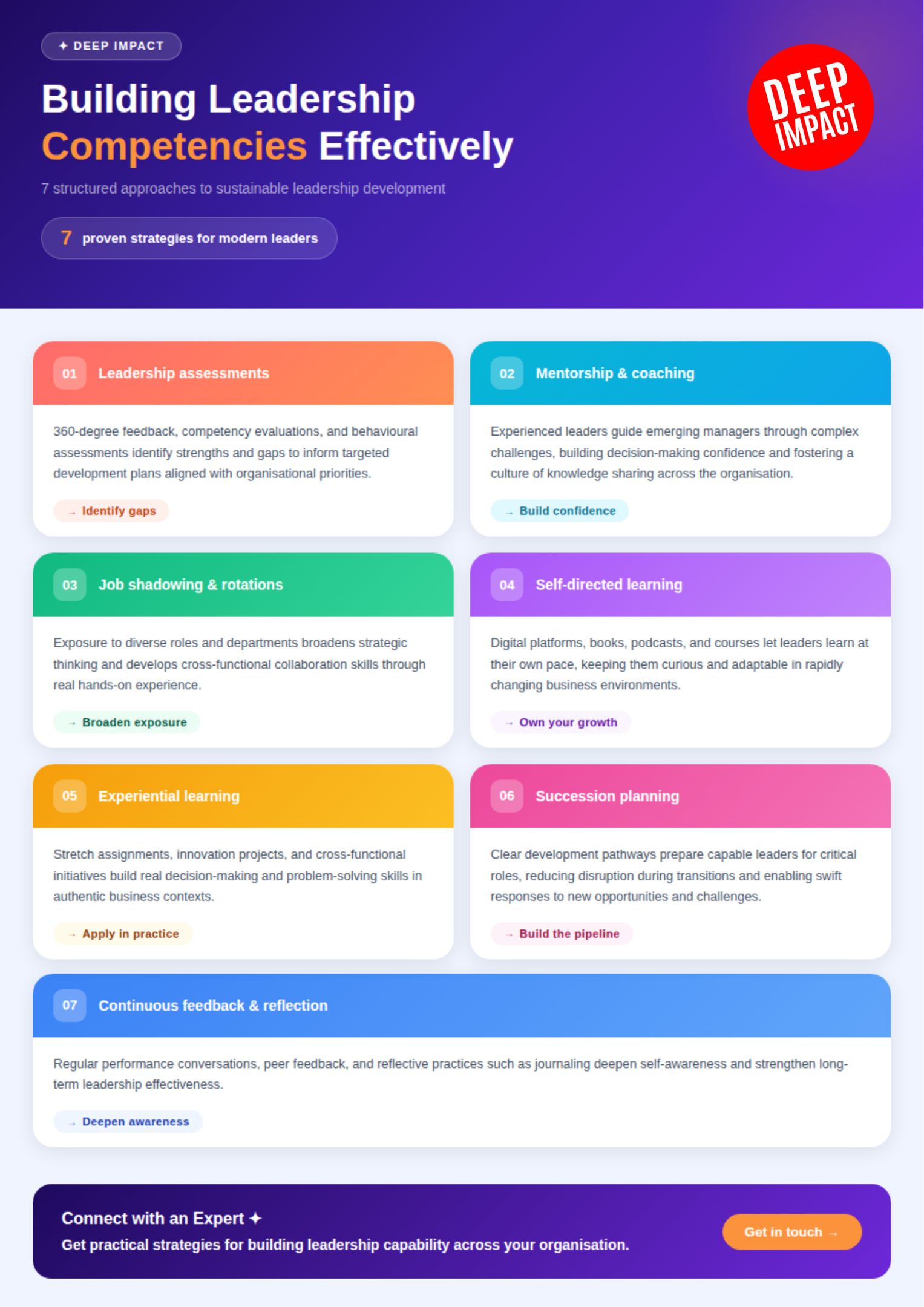
Structured leadership development can include the following approaches:
Leadership assessments
Leadership assessments provide valuable insights into current capability levels and development opportunities. Tools such as 360-degree feedback, leadership competency evaluations, and behavioural assessments help organisations identify strengths and areas for improvement. HR teams and senior leaders can use these insights to design targeted development plans that align with organisational priorities.
Mentorship and coaching
Mentorship and coaching play a critical role in leadership development. Experienced leaders guide emerging managers through complex challenges, offering perspective, encouragement, and practical advice. Coaching conversations also help individuals reflect on their behaviours, strengthen decision-making skills, and build confidence in leadership roles. Over time, mentorship relationships foster a culture of knowledge sharing and continuous improvement across the organisation.
Job shadowing and rotational assignments
Exposure to diverse roles and responsibilities accelerates leadership capability. Job shadowing allows emerging leaders to observe experienced executives navigating real business situations. Rotational assignments provide hands-on experience across departments, broadening understanding of organisational operations and strategic priorities. Leaders who experience multiple business functions develop stronger strategic thinking and cross-functional collaboration skills.
Self-directed learning
Modern leadership development increasingly incorporates self-directed learning. Digital learning platforms, leadership books, podcasts, and professional development courses allow leaders to learn at their own pace. Curiosity and initiative become powerful drivers of growth when individuals take ownership of their development journey. Organisations that encourage continuous learning help leaders remain adaptable in rapidly changing business environments.
Experiential learning and practical projects
Real leadership capability develops when individuals apply new knowledge in practical situations. Stretch assignments, innovation projects, and cross-functional initiatives allow emerging leaders to practise decision-making, communication, and problem-solving skills in authentic business contexts. Experiential learning strengthens confidence while reinforcing theoretical concepts learned in training programs.
Succession planning
Succession planning ensures that organisations maintain a strong pipeline of capable leaders prepared to step into critical roles. Clear development pathways help employees understand potential career progression and motivate them to build leadership competencies. Leadership pipelines also reduce disruption during organisational transitions and enable companies to respond quickly to new opportunities or challenges.
Continuous feedback and reflection
Leadership growth depends heavily on feedback and reflection. Regular performance conversations, leadership reviews, and peer feedback encourage individuals to evaluate their leadership approach and adjust behaviours accordingly. Reflective practices such as journaling, leadership discussions, and coaching sessions deepen self-awareness and strengthen long-term leadership effectiveness.
Integration of these development methods across all organisational levels creates a strong leadership culture. Employees gain clarity about expectations, managers receive the support needed to grow, and organisations benefit from leaders who can adapt to change while maintaining strategic focus.
Consistent investment in leadership development also signals that organisations value people as their most important asset. Strong leadership pipelines enable companies to sustain performance, navigate complexity, and foster environments where employees feel motivated to contribute their best work. Over time, leadership competency development becomes not just a training initiative but a core driver of organisational success.
Conclusion
Strong leadership competencies underpin organisational success, influencing culture, performance, and employee experience. Competencies such as emotional intelligence, communication, learning agility, change management, and people management distinguish thriving organisations from those struggling to maintain relevance.
Embedding these competencies into leadership frameworks allows organisations to cultivate high-performing teams, nurture continuous learning, and secure long-term success. Leadership is a deliberate practice; developing these skills ensures that both leaders and their organisations are prepared to navigate complexity, inspire teams, and achieve sustainable results.
Investing in leadership competencies is not merely a human resources initiative; it is a strategic imperative that shapes organisational outcomes, employee engagement, and market competitiveness for years to come.
Let’s Build Something Great Together
We know that great leadership doesn’t happen by accident and neither does the work we do at Deep Impact. Whether you’re nurturing your next generation of leaders or looking to strengthen your senior team, we’ll work with you to build something that fits your people, your culture, and your ambitions.
If this resonates with you, we’d love to have a conversation. Reach out to the Deep Impact team today because the organisations that invest in their leaders today are the ones shaping tomorrow.
Read More: Building trust as a leader: how strong is your trust level?