 Book Free Consultation

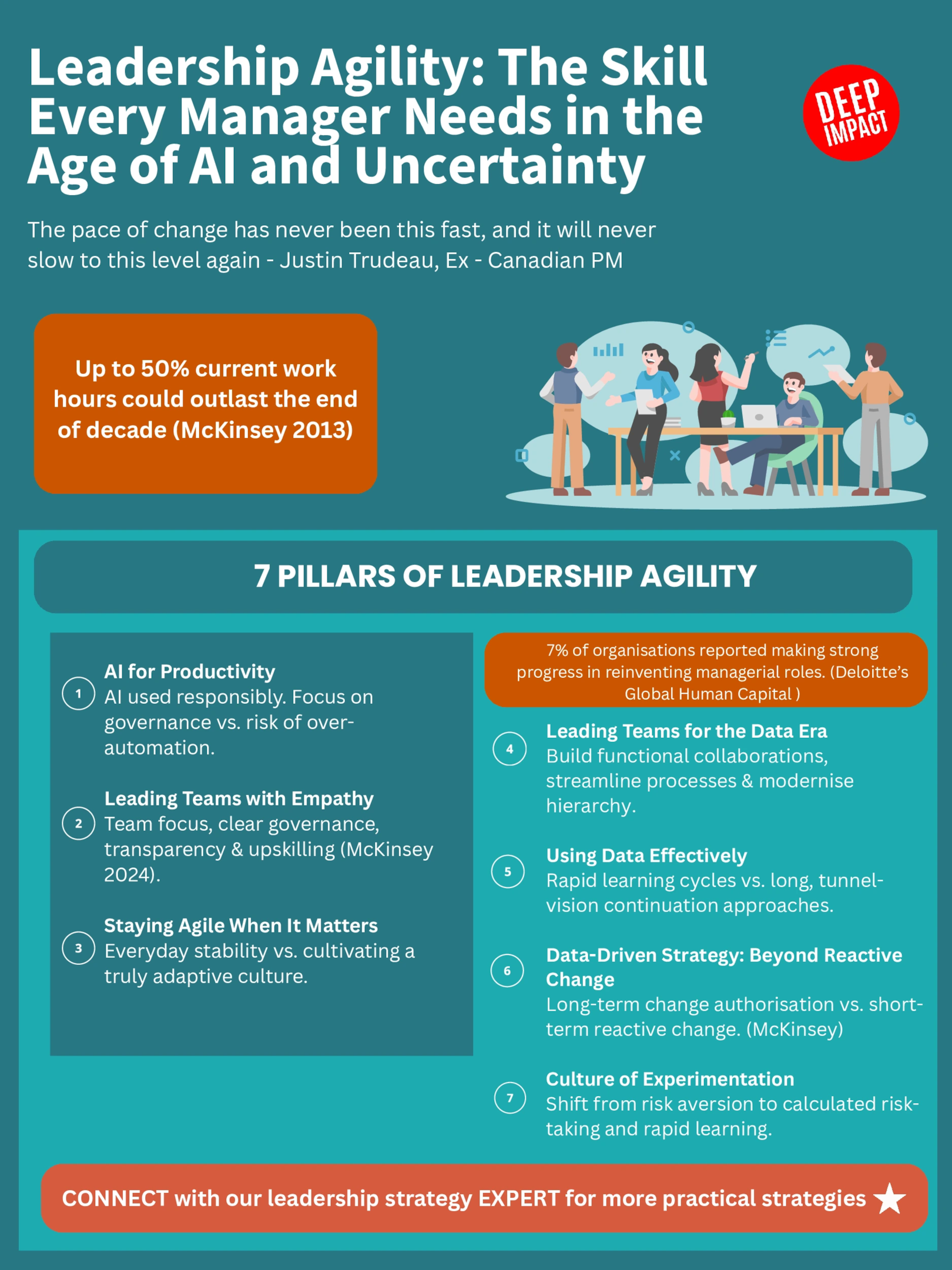
‘The pace of change has never been this fast, and it will never be this slow again.’ Ex-Canadian Prime Minister Justin Trudeau’s words, though spoken years ago, are more relevant than ever as AI reshapes workplaces at unprecedented speed. Generative AI is no longer emerging; it is actively transforming how organisations operate. According to McKinsey (2023), up to 30% of current work hours could be automated by the end of the decade. For managers, this is not just a statistic; it is a reality that demands new approaches in organisation and leadership development.

Leaders are now making decisions with incomplete information and guiding teams through technological disruption. They must also keep pace with tools that evolve faster than training programs. Traditional leadership styles are often insufficient in this environment, creating a pressing need for agile leaders with a co-creator mindset and strong problem-solving skills who embody leadership agility.
Leadership agility addresses this need. Agile leaders stay open, curious, and flexible while maintaining direction. They sense shifts early, respond thoughtfully, and engage employees transparently. Research from the Harvard Business Review shows that leaders grow and consistently outperform during periods of volatility, navigating rapid change before challenges escalate, showcasing the leader’s ability to adapt.
In Asian workplaces, where relationships, hierarchy, and cultural nuance influence communication and decision-making, agility is even more critical. Leaders must balance technological competence with emotional intelligence and human connection. As AI continues to shape collaboration, managers who cultivate greater agility will lead their teams confidently, turning uncertainty into opportunity.
This article explores why effective leadership agility is essential and offers practical strategies for personal development, organizational development, and creating sustained success in rapidly changing environments.
1. Adaptive Leadership Development for Asian Workplaces
Asian leadership has long been shaped by deeply rooted cultural norms: hierarchy, respect for seniority, and a strong sense of collectivism. These foundations have traditionally developed workplaces that value stability, clarity of roles, and group harmony. Yet today, as markets across the region face rapid change from AI disruption to supply chain uncertainty and intensifying regional competition leaders are under mounting pressure to make faster, more forward-looking decisions at various leadership levels. The need for agile management has never been more pressing.
Modern Asian leaders are navigating a delicate balancing act. Teams still expect clear direction and respect for established structures, but organisations increasingly require more collaborative and fluid decision-making to stay competitive. This tension raises an important question: How do you honour hierarchy while enabling quicker, more distributed decision-making in your leadership style?
A key shift is moving from positional authority to capability-driven leadership. Instead of relying solely on title or tenure, today’s Asian leadership requires culturally aware leadership, transparency, and the agility to involve the right people, regardless of rank, when solving complex issues. Leaders who can respond between structure and empowerment develop environments that maintain stability while allowing adaptability to flourish.
Deloitte’s research reinforces the urgency of this shift: in its recent Global Human Capital Trends study, only 7% of organisations reported making strong progress in reinventing managerial roles, even though the vast majority of organisations recognise that transformation is essential. This highlights a clear gap between intent and action, particularly relevant for Asia’s rapidly evolving markets.
Case studies like DBS Bank show what this transformation looks like in reality. DBS built a model centred on leadership agility, forward thinking, and rapid experimentation. Crucially, it retained cultural respect for structure while redesigning decision flows and rewarding leaders for enabling new competencies and responsibilities with a common good rather than simply overseeing operations.
Ultimately, coaching adaptive leadership in Asia is about embracing the region’s unique cultural strengths while equipping most leaders for volatility. In markets where expectations shift quickly, and competition is intense, agility is no longer optional. It is becoming the defining leadership competency for navigating different situations at their current level.
2. AI for Productivity and Innovation in Asian Teams
AI is increasingly reshaping daily workflows in Asian organisations, offering managers opportunities to enhance team productivity with AI, streamline processes, and free up time for strategic thinking, new ways, and stakeholder engagement. Introducing AI requires careful planning: managers must balance efficiency gains with responsible use, providing transparent governance and ensuring teams are not overwhelmed by new ways and emerging solutions.
Singapore’s leadership approach focuses on national-level coordination, combining government support, clear standards, and investment in skills. AI is applied across healthcare, smart estates, and education, enabling predictive analytics, adaptive learning, and real-time citizen services. Prioritising responsible AI use and workforce upskilling allows organisations to boost productivity with AI, foster new thinking, and embed technology without undermining trust or ethics.
Japan’s approach is grounded in precision, quality, and operational excellence. AI is widely used in manufacturing for predictive maintenance, monitoring machinery to prevent unplanned downtime, and in logistics to optimise supply chains. Companies also deploy AI in energy management, reducing consumption in data centres, and in healthcare and banking to streamline operations. This strategy mirrors Japan’s deeply held cultural commitment to continuous improvement, strengthening leaders’ ability to position AI as a complement to established lead thinking processes rather than a disruptive force, especially in rapidly changing environments.
McKinsey’s latest global AI survey 2024 adds weight to these observations. It found that 72% of companies have embedded at least one AI capability into a business function, and about half of organisations in developed Asia-Pacific now use AI across two or more business units, nearly doubling adoption compared with previous years. For generative AI specifically, 65% of respondents reported regular use in at least one function. While most organisations plan to increase their AI investment over the next three years, only a minority of “high-performer” companies are scaling effectively, reporting on average 11 distinct AI use cases compared to roughly three for other firms, fostering innovative thinking programs and more strategic solutions.
These examples and the McKinsey data together demonstrate that AI adoption in Asia is not just about experimentation: when aligned with governance, local culture, and AI leadership, it becomes a powerful lever for productivity, ability, and sustainable growth in the business world.
3. Leading Teams with Empathy in Asia’s High-Tech Era
Empathy is becoming a strategic advantage in Asian workplaces, offering leaders opportunities to strengthen cross-cultural empathy, enhance an agile mindset, and increase engagement even amid rapid technological change. Leading with empathy requires careful attention: managers must balance culturally sensitive communication with generational differences, building trust while demonstrating agility and navigating the pressures of high-tech workflows.
Singapore’s approach to workplace empathy, reflected in multinational and hybrid teams, emphasises psychological safety and structured emotional support. Google’s Project Aristotle showed that teams with high psychological safety consistently outperformed others because members felt safe to speak up, take risks, and share ideas without fear of embarrassment or backlash. The research found that when employees practised behaviours like balanced turn-taking, social sensitivity, and respectful dialogue, they collaborated more openly and solved problems more creatively. In these high-trust environments, people were more engaged, more comfortable asking for help, and more willing to challenge assumptions leading to stronger overall performance.
Japan’s approach highlights the importance of indirect communication, harmony, and respect for hierarchy. Leaders in Japanese organisations adapt feedback and guidance to align with social norms, helping to bridge generational expectations. For example, Gen Z’s desire for autonomy while maintaining structures valued by Gen X. Research on AI-enhanced empathy, such as the Hailey RCT study, demonstrates how digital tools can augment human emotional intelligence, providing timely cues and recommendations while managing empathic interaction with cultural awareness without undermining authenticity.
Local evidence from HRM Asia also reinforces these trends, showing that employees in hybrid workplaces increasingly value meaningful connection, transparent communication, and leaders who demonstrate emotional awareness. These insights collectively demonstrate that empathy is not merely a soft skill: when integrated with cross-cultural sensitivity, structured organisational practices, it becomes a critical lever for group engagement, innovation, and resilient leaders in a high-tech, rapidly changing business world.
4. Staying Agile Amid Rapid Change and Uncertainty
Agility has become essential for Asian organisations facing volatile markets, technological disruption, and rapid changes in consumer behaviour. Building in Asia is challenging, as many organisations still operate within hierarchical and collectivist cultures that can slow decision-making and limit experimentation. Leaders must therefore find ways to combine flexible decision-making with respect for existing structures, creating environments where teams can respond quickly and embrace agility without undermining authority or cohesion.
One approach is to introduce rapid feedback loops that allow groups to learn, focus and adapt in real time. Short retrospectives, frequent check-ins, and small-bet experiments enable people to test agility ideas, learn from failure, and iterate without risking large-scale disruption. Encouraging constructive dissent and cross-functional collaboration helps collectivist groups challenge assumptions safely, fostering innovation while maintaining harmony and adapting to new responsibilities.
Resilient teams are built when leaders actively balance structure with flexibility. This includes setting clear objectives, creating space for members to experiment, rotating lead responsibilities to build adaptability, and creating cross-functional squads that can pivot quickly when priorities shift. Practical examples include Grab’s rapid pivot model during COVID-19, where the company rapidly transitioned thousands of drivers from ride-hailing to delivery services almost overnight. By empowering teams to reconfigure operations at speed, Grab showed how agile leadership enables organisations to adapt, protect livelihoods, and stand up new services under intense pressure.
Developing resilient internal groups in this way requires cultural awareness, intentional processes, and strong leadership. When leaders embed agility into the rhythm of work through feedback, experimentation, and flexible structures, organisations can respond to rapidly changing conditions effectively while preserving cohesion, trust, and long-term performance.
5. Using Data Effectively Without Losing Human Context
Rising reliance on AI-generated dashboards, analytics, and forecasting is transforming how Asian organisations make decisions. However, leaders must be cautious of data absolutism, that is, the risk of prioritising numbers over frontline experience and contextual understanding. Making strong decisions requires balancing AI insights with human judgement, ensuring that quantitative signals are enriched by cultural insight, intuition, and relational act.
Asian leaders often develop and rely on informal communication and relationship networks to supplement formal data. Engaging with members, listening to regional perspectives, and drawing on local knowledge helps to interpret analytics meaningfully. This combination significantly provides contextual decision-making, ensuring that strategies are not only data-informed decisions but also grounded in the realities of teams, customers, and stakeholders.
A practical approach is a hybrid decision-making model, where AI-generated insights guide options, human context refines understanding, and feedback validates decisions. Sales teams, for example, often cross-check AI forecasts against regional market conditions and customer sentiment, avoiding over-reliance on predictive models. McKinsey case studies on blended decision models further illustrate that organisations achieve better outcomes when data is integrated with human judgement and collective intelligence.
Leaders who master Leading Teams Through AI Integration understand that numbers alone do not drive success. Decisions become stronger and more resilient when AI insights are combined with input, local knowledge, and careful attention to context creating a balance between technological capability and human insight.
6. Keeping Remote and Hybrid Teams Connected
Remote and hybrid work varies widely across Asian countries, influenced by cultural norms, time zones, and organisational expectations. Leaders face challenges such as employees’ preference for in-person connection, reliance on seniority cues, and stretched schedules across multiple time zones. To maintain remote team engagement and cross-cultural collaboration, managers must intentionally build trust and manage spaces where all voices, including quieter ones, are heard a capability that increasingly reflects modern leadership agility.
More effective leadership practices include regular virtual huddles, asynchronous collaboration tools, and regional town halls that foster visibility and connection. Establishing consistent rituals helps hybrid teams feel included, reduces misunderstandings, and ensures alignment across geographies.
Fujitsu, for example, has implemented its “Work Life Shift” initiative across Asia, redesigning offices and deploying hybrid IT support solutions, including a conversational AI chatbot and self-service portal, to connect distributed teams while maintaining productivity and trust. This approach demonstrates how hybrid team management can be scaled effectively in relationship-driven, cross-cultural contexts.
7. Future-Proofing Leadership Skills for Asian Managers
Continuous learning has become a core leadership development in Asia, as managers must navigate AI adoption, skill sets, hybrid work, and rapidly shifting market dynamics. Developing leadership skills in Asia now includes AI readiness, change management, cross-cultural communication, and scenario planning all essential to maintaining relevance and guiding competencies effectively.
Research underscores the impact of learning-oriented leadership. The World Economic Forum reports that 59% of workers globally need upskilling by 2030, while McKinsey found that leadership teams committed to continuous learning outperform others by four times in transformation initiatives. Formal and informal mentorship, region-specific peer networks, and communities of practice provide Asian managers with opportunities to share insights, benchmark practices, and stay attuned to emerging trends.
Practical steps include developing a personal learning roadmap, building awareness of emerging trends, and setting aside dedicated time to upskill in AI tools, hybrid management approaches, and new people-insights frameworks. Leaders who seek out both structured and experiential learning opportunities not only future-proof their own capabilities but also model a culture of continuous development. This proactive mindset empowers team members to adapt with confidence, innovate boldly, and thrive amid rapid technological and organisational change.
Initiating Change & Growth as an Agile Leader
The rise of AI and persistent market uncertainty across Asia has irrevocably changed the nature of management, making leadership agility the defining skill for mastering complexity in hybrid workplaces. The most effective leaders recognise this new operating context and actively cultivate specific abilities, adaptability, curiosity, skill sets, and empathy, positioning their teams not just to survive disruption but to seize business opportunities and sustain engagement.
Commanding leadership combines incisive insights from data with essential human understanding and awareness, establishing a deliberate cadence of reflection and clear direction that strengthens both team confidence and capability.
Translating this insight into action means establishing a deliberate practice of agility and leadership style. This manifests as proactive, critical interventions: prioritising focused one-to-ones to capture nuanced team needs, cultivating psychological safety to enable rapid feedback and safe experimentation, and building reflective loops around decisions to refine future responses all while expertly navigating the inherent cultural nuances and hierarchical expectations within Asian organisations.
We must, therefore, conclude with a challenge to leaders at all levels: Is your leadership truly agile, committed to continuous learning, and consistently enabling excellence within this rapidly transforming environment? Taking this self-assessment provides more than a review; it reveals precise opportunities to solidify your professional mastery, strategically experiment with high-leverage approaches, and fundamentally develop your influential impact as a leader.
You might also like : Leadership Development Program for Managers Focused on Confidence and Impact